Metropolitan Group and Spitfire Strategies on why the new Pro-Democracy Narrative Framework can be transformative for higher education messaging.
Originally published on the AAC&U’s APT Words newsletter
The following guest post is written by Kevin T. Kirkpatrick and Nima Shirazi. Kevin is the head of the strategic communication practice and a principal at Metropolitan Group, a strategic and creative consulting agency with a mission to amplify the power of voice of change agents in building a healthy, just, and sustainable world. Nima is a narrative strategist, media analyst, and senior vice president at Spitfire, a public interest communication and advocacy firm rooted in the core principles that everyone belongs and has the power to spark change.
The promises of higher education and democracy go hand in hand.
A free, fair, and inclusive democracy benefits from institutions where people can pursue knowledge, encounter different ideas, develop the skills to contribute to their communities, and conduct research that helps society solve hard problems. Higher education, in turn, thrives on democratic principles: freedom of inquiry, fairness, and pluralism. Colleges are anchors of community, each strengthening the other.
Colleges and universities have been grappling with a vital question for years: what can higher education do to earn and sustain the public’s confidence? AAC&U’s Advancing Public Trust in Higher Education (APT) initiative takes that question seriously. Its report, The Trust Agenda, starts from the premise that trust cannot simply be communicated into existence — institutions earn it through relationships, responsiveness, and actions that advance the public good. As The Trust Agenda puts it, trust grows through “promises made and promises kept.”
But a kept promise needs the public to recognize that it has been kept. That recognition relies on narrative as much as on fact. Narrative is the currency of belief, shaping what people think and feel about the world — not necessarily what’s true, but what feels real. And how people feel about higher ed is often a bellwether for how much they trust public-serving institutions overall.
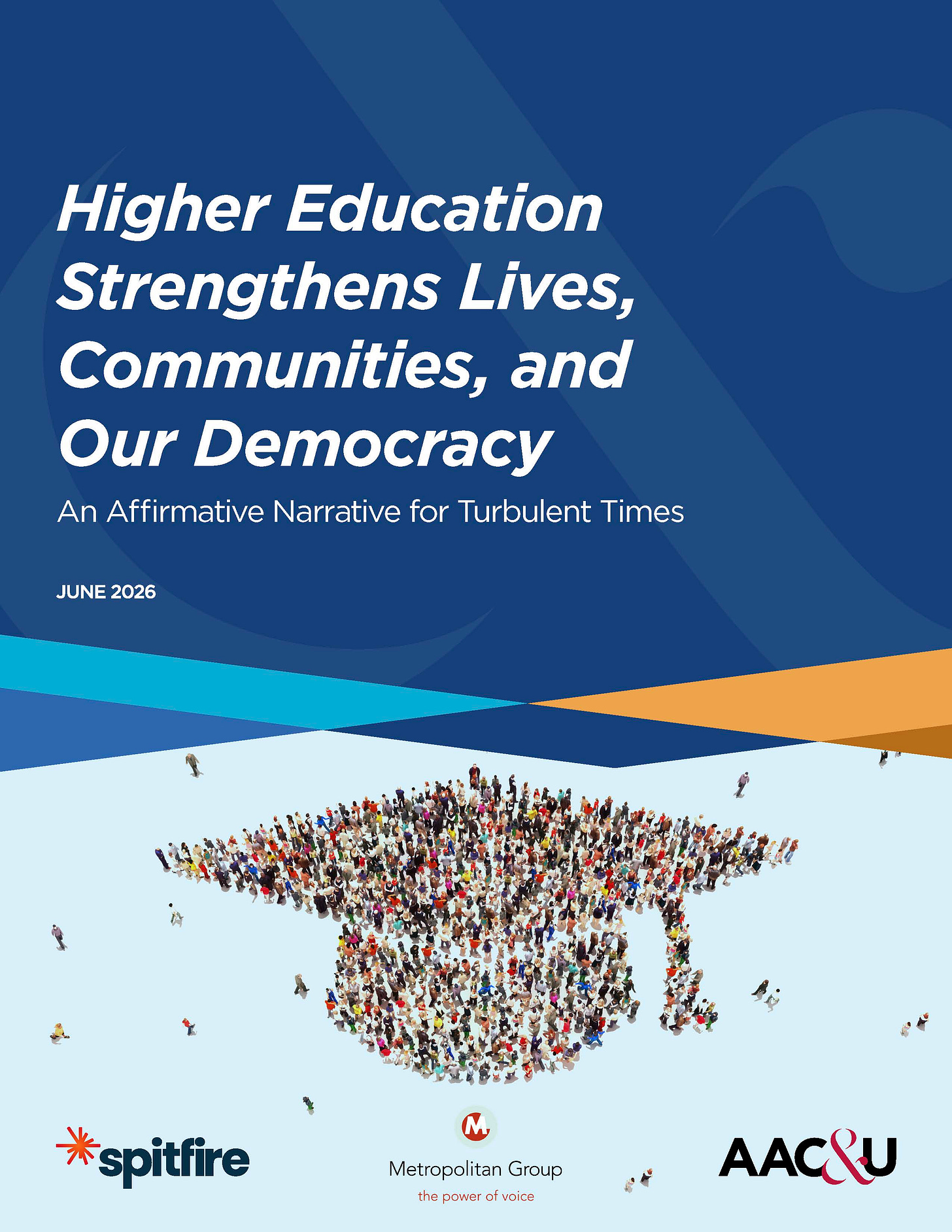
Alongside a cohort of higher education leaders, including representatives from AAC&U, Metropolitan Group and Spitfire Strategies have created Higher Education Strengthens Lives, Communities, and Our Democracy: An Affirmative Narrative for Turbulent Times. The new narrative and messaging framework described in this guide offers a research-informed way to share a more powerful story, grounded in shared values, everyday impact, and honest self-reflection. Read alongside The Trust Agenda, it prompts an important question: how can colleges and universities more fully live that story, instead of just telling it?
A public story grounded in shared values
The framework centers higher education’s story on widely shared values, particularly freedom: the freedom to learn, explore ideas, pursue opportunity, contribute to society, and shape our own future. It defines democracy as something people experience in everyday life — not simply at election time, but when people talk to their neighbors, speak freely, support their communities, and solve problems together.
It also asks institutions to make their public benefits tangible: the jobs and positive impact on local economies, research and innovation, and the places they create for people to learn from each other. Finally, it emphasizes honesty. Affordability and access are real challenges, and a compelling public story doesn’t obscure them; it addresses them head-on.
From talking points to proof points
It might be surprising to hear this from a couple of communications strategists, but it’s unfortunately true: words alone aren’t enough. Proof — whether a personal story or a potent statistic — is ultimately more powerful than any platitude. Compelling narratives need emotion, energy, and clarity. As every good writing teacher will tell you on the first day of class: show, don’t tell. For each of The Trust Agenda’s named priorities, that means answering real questions with real evidence of impact.
When prioritizing community engagement, ask yourself honestly who outside the student body is genuinely better off because of your institution, and whether they’d say so unprompted. Accelerating innovation, in The Trust Agenda’s own candid language, means solving problems “without external pressure.” What has changed at your school this year that was driven by students and faculty, rather than as a reaction to media headlines? Recommitting to inclusive excellence means knowing which students are least likely to complete a degree or credential, what their needs are, and how best to support them. And coordinating a mission-centered defense takes both accountability and solidarity: the last time your institution’s independence was tested, can you say plainly what you did and whom you stood beside?
Answer these questions with humility instead of hubris, and you’ll have more than just talking points. You’ll have proof points: hard evidence of value that people actually experience and internalize.
Make the work visible
Of course, doing good work doesn’t guarantee that people will know about it. That’s why The Trust Agenda also recommends telling a clearer story about your institution’s accomplishments, and connecting that story to things people already care about: good jobs, healthy communities, having their voices heard, and having the ability to lead the lives they want and to provide for those they love.
Renewing the social contract between higher education and the public, therefore, requires telling and doing, then telling again and doing even more. Each new proof point is a story to be told; each story is another tile in the mosaic of a public narrative — one not only believed, but lived and experienced by the communities your institution exists to serve.
Narrative is a lens, not a script
We encourage readers to use the new guidance to build strong messages for higher education and to identify local proof points. But even more critically, we encourage you to use it as a lens: who currently decides what counts as proof that a college is living its values, and how can community members, not just administrators, have a more meaningful role in shaping that answer?
A powerful narrative should do more than just describe higher education’s democratic value. It should deepen that value.
That’s ultimately how public trust will be built. Stories and action have to move together toward higher education’s essential role in a free, fair, and inclusive democracy, and toward strengthening these institutions so that people can see and experience that story for themselves.
That’s how narrative becomes more than a message: when the facts on the ground are felt in your gut. When beliefs are backed up by tangible examples. And when it’s built on trust and truth, that narrative becomes the promise you work every day to keep.